
BRAZIL STORY
From Religious Intolerance to Mutual Understanding
In Brazil, Koinonia brings Afro-Brazilian and Christian communities together to confront religious intolerance and build relationships rooted in dignity, respect, and mutual understanding. Through dialogue and shared experience, people separated by religious and cultural differences discover what becomes possible when they truly encounter one another.
Brazil is home to a remarkable diversity of religious and cultural traditions. Yet for many Afro-Brazilians, that diversity has not always meant acceptance. Communities rooted in African religious traditions have faced prejudice, discrimination, and religious intolerance—experiences intertwined with Brazil’s long history of racism and the marginalization of African-descended people.
Koinonia has worked alongside these communities to create spaces where another kind of relationship can take root. Rather than allowing fear or misunderstanding to define encounters between people of different traditions, Koinonia brings people together for honest conversation, shared learning, and the patient work of building trust.
These gatherings create opportunities for Afro-Brazilian religious leaders, Christians, community members, and advocates to listen to one another and confront the assumptions that too often divide them. The goal is not to erase religious differences or persuade people to abandon their traditions. It is to affirm the dignity of each person, defend the right of communities to practice their faith without fear, and discover how people of different beliefs can stand together against intolerance.
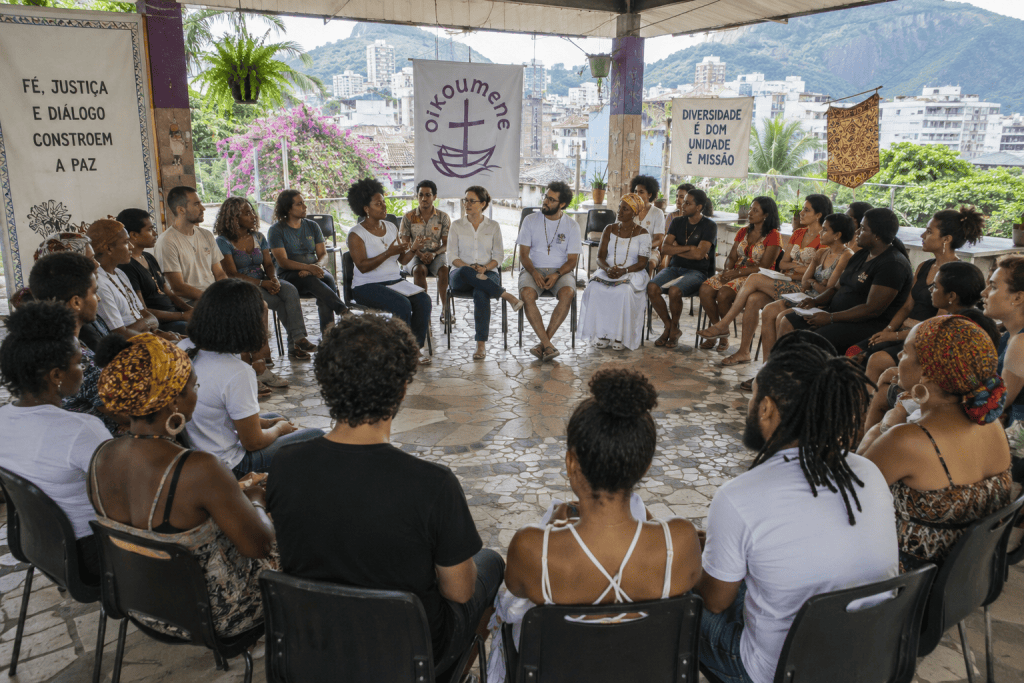
Illustrative of an ecumenical gathering in Rio.

Interreligious dialogue in Brazil. Photo: Varginha Digital.
Koinonia responded by creating spaces where people who too often encounter one another through stereotypes could instead meet face to face. Afro-Brazilian religious leaders, Christians, community advocates, and others were invited into circles of dialogue—not to debate whose beliefs were right, but to listen, learn, and recognize one another’s dignity.
The conversations opened room for participants to speak honestly about religious intolerance and the racism that often lies beneath it. Afro-Brazilian participants could name experiences of discrimination and violence against their religious communities. Christian participants were invited to listen to those experiences, examine assumptions within their own communities, and consider what solidarity might require of them.
But Koinonia’s work extends beyond conversation. Through education, advocacy, community organizing, and accompaniment, the ministry helps historically marginalized communities understand and defend their rights while strengthening relationships among people committed to justice and religious freedom.
Gradually, dialogue becomes relationship. People who might otherwise have remained separated by suspicion begin to know one another as neighbors and partners. Differences remain, but they no longer have to become barriers. In their place grows the possibility of mutual respect—and a shared commitment to confronting intolerance wherever it appears.
trannsformation
When Dialogue Becomes Relationship
The transformation begins when people who have been defined by labels begin to know one another as neighbors. Through Koinonia’s work, dialogue creates relationships in which participants can speak honestly about religious intolerance, racism, and the experiences of Afro-Brazilian communities—and know that their voices are being heard.
For communities whose religious traditions have often been treated with suspicion or hostility, being recognized as full participants in public and religious life is itself significant. The work strengthens the ability of Afro-Brazilian leaders and communities to claim their rights, preserve their traditions, and speak from their own experience rather than allowing others to define them.
Relationships across religious traditions also create new possibilities for solidarity. Christians and practitioners of Afro-Brazilian religions do not need to minimize their differences in order to recognize a shared responsibility to defend human dignity and religious freedom. People who once might have encountered one another primarily through misunderstanding can instead become partners in confronting intolerance.
encounter with Christ
Partnership Makes Ministry Possible
The transformation begins when people who have been separated by stereotypes and suspicion begin to know one another as neighbors. Through Koinonia’s work, dialogue creates relationships in which participants can speak honestly about religious intolerance, racism, and the experiences of Afro-Brazilian communities—and know that their voices are being heard.
For communities whose religious traditions have often been marginalized, that recognition matters. Afro-Brazilian leaders and communities are strengthened in their ability to claim their rights, preserve their traditions, and speak from their own experience rather than allowing others to define them.
Relationships across religious traditions also create new possibilities for solidarity. Christians and practitioners of Afro-Brazilian religions do not have to minimize their differences in order to recognize a shared responsibility to defend human dignity and religious freedom. People who might once have encountered one another primarily through misunderstanding can instead become partners in confronting intolerance.
These relationships do not erase generations of racial and religious prejudice. But they create something essential for lasting change: communities better equipped to advocate for themselves, people willing to listen across deeply held differences, and relationships strong enough to withstand those differences.
Dialogue, then, becomes more than conversation. It becomes a foundation for solidarity.
Help Make Transformation Like This Possible
Your generosity strengthens partnerships with ministries like Koinonia, helping locally led communities across Latin America and the Caribbean confront injustice, build relationships across difference, and affirm the dignity of every person.